Asset management & reliability engineering

Know what you own,
what condition it's in,
and what it will cost you.

B Industries builds the asset register, assesses the condition, prices the gap and writes the maintenance program — for schools, hospitals, warehouses and small manufacturers who were never going to get this from a national engineering firm.

5
4
3
2
1
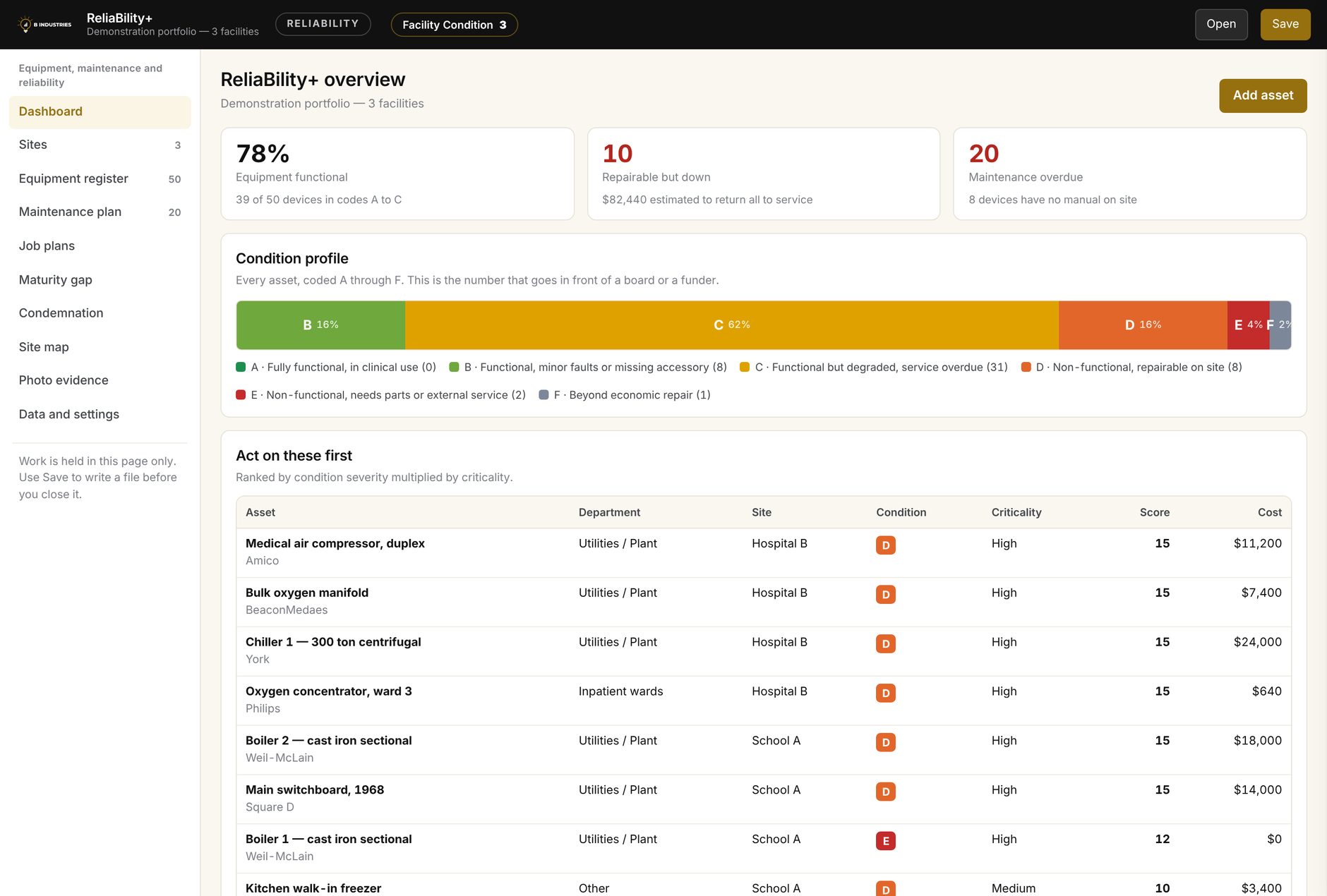
Every building element and every piece of equipment you own sits somewhere on this scale. Most organisations cannot say where. That is where we start.
10+
Years in reliability and asset management
CMRP
Certified Maintenance & Reliability Professional
1,300+
Equipment and instrument classes in our task library
GxP
Regulated pharmaceutical and medical device experience
What we do

Asset management,
start to finish.

Two disciplines, applied together: the condition of the buildings you occupy, and the reliability of the equipment inside them. Most organisations manage one badly and the other not at all.

Facility condition assessment

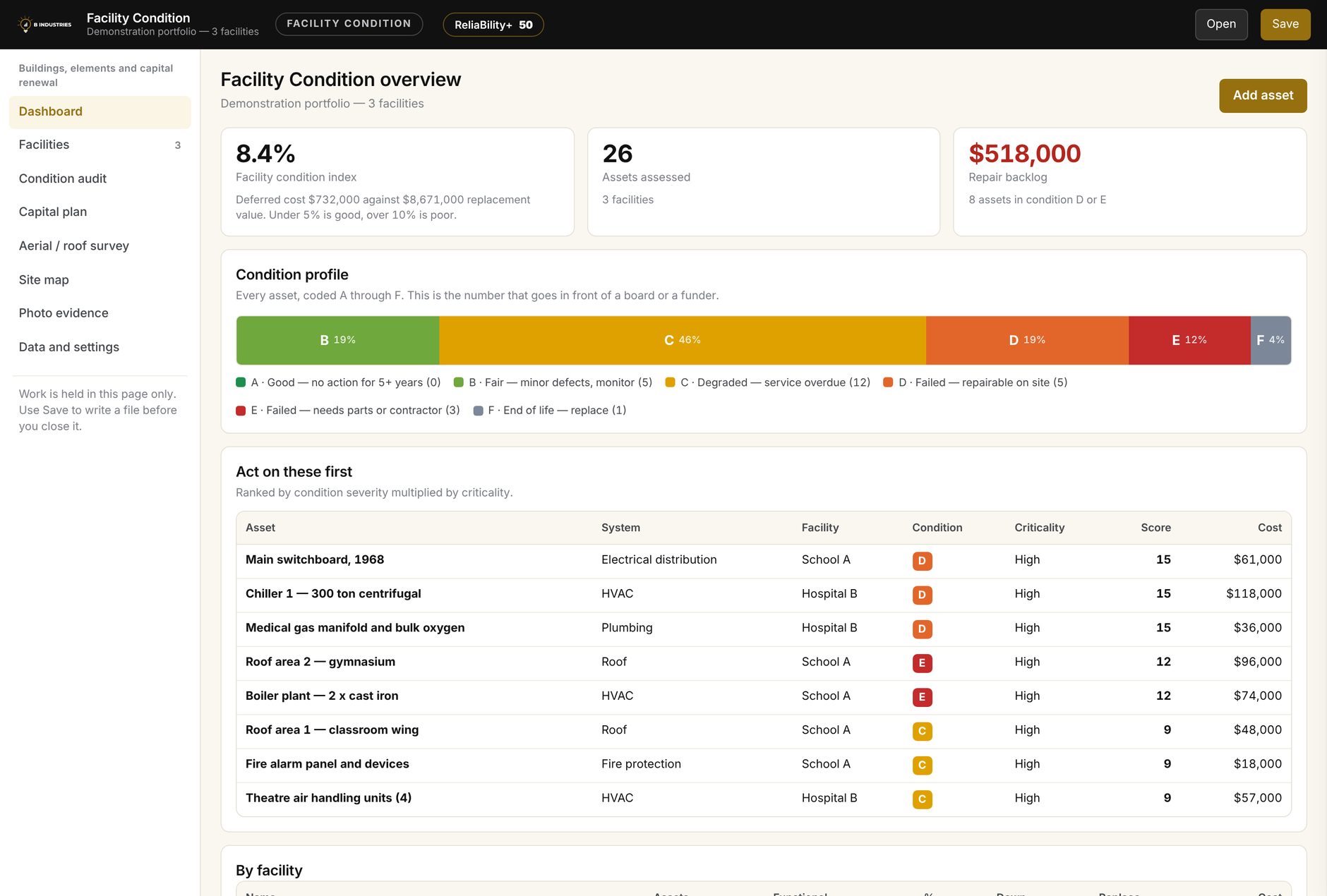
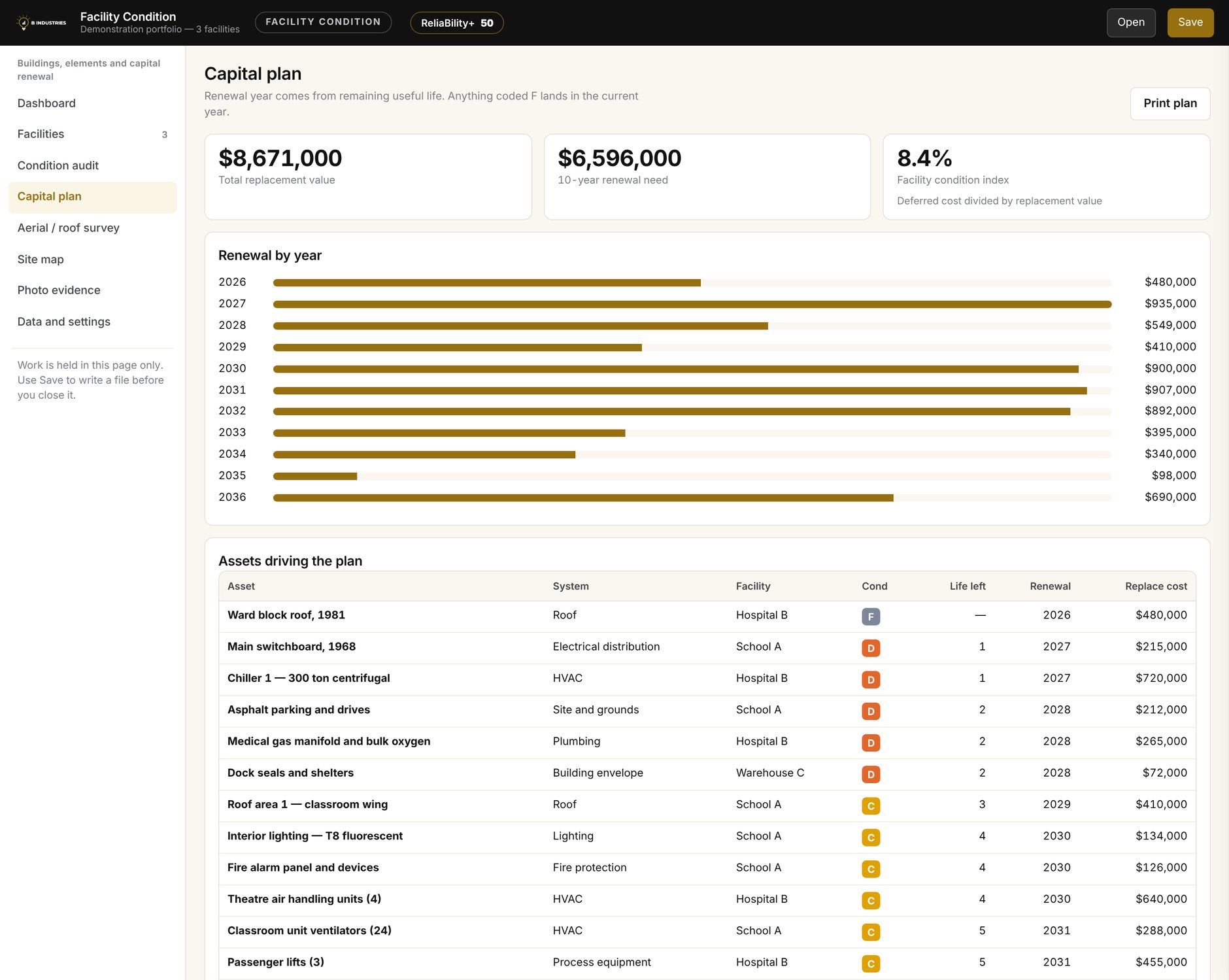
Your buildings broken down to the ASTM E1557 UNIFORMAT II elemental standard, condition-rated element by element, and turned into a Facility Condition Index, a deferred maintenance backlog and a ten-year capital renewal plan.

How it works →

Reliability & maintenance programs

Equipment asset registers with criticality ranking, preventive maintenance task plans written failure-mode first, and the gap between what you do today and where you should be — quantified in labour hours and dollars.

How it works →

Industrial performance and efficiency

OEE definition and measurement that survives scrutiny, KPI and OPI development, loss analysis, and energy and utilities cost reduction. Offered to clients where the maintenance work has already landed and the next constraint is throughput rather than uptime.

Facility condition assessment

Built on UNIFORMAT II,
not on a clipboard.

We assess buildings using the ASTM E1557 UNIFORMAT II elemental classification — the same standard used for building cost estimating, so the condition data lines up with the way costs are actually structured. Seven major groups, 22 group elements, 79 individual elements.

ASubstructureFoundations, slab on grade, basement construction.
BShellSuperstructure, exterior walls, windows and doors, roofing.
CInteriorsPartitions, doors, fittings, stairs, wall, floor and ceiling finishes.
DServicesConveying, plumbing, HVAC, fire protection, electrical.
EEquipment & FurnishingsInstitutional, commercial and vehicular equipment, fixed furnishings.
FSpecial ConstructionSpecial structures and systems, and hazardous components abatement.
GBuilding SiteworkSite preparation, improvements, mechanical and electrical utilities.
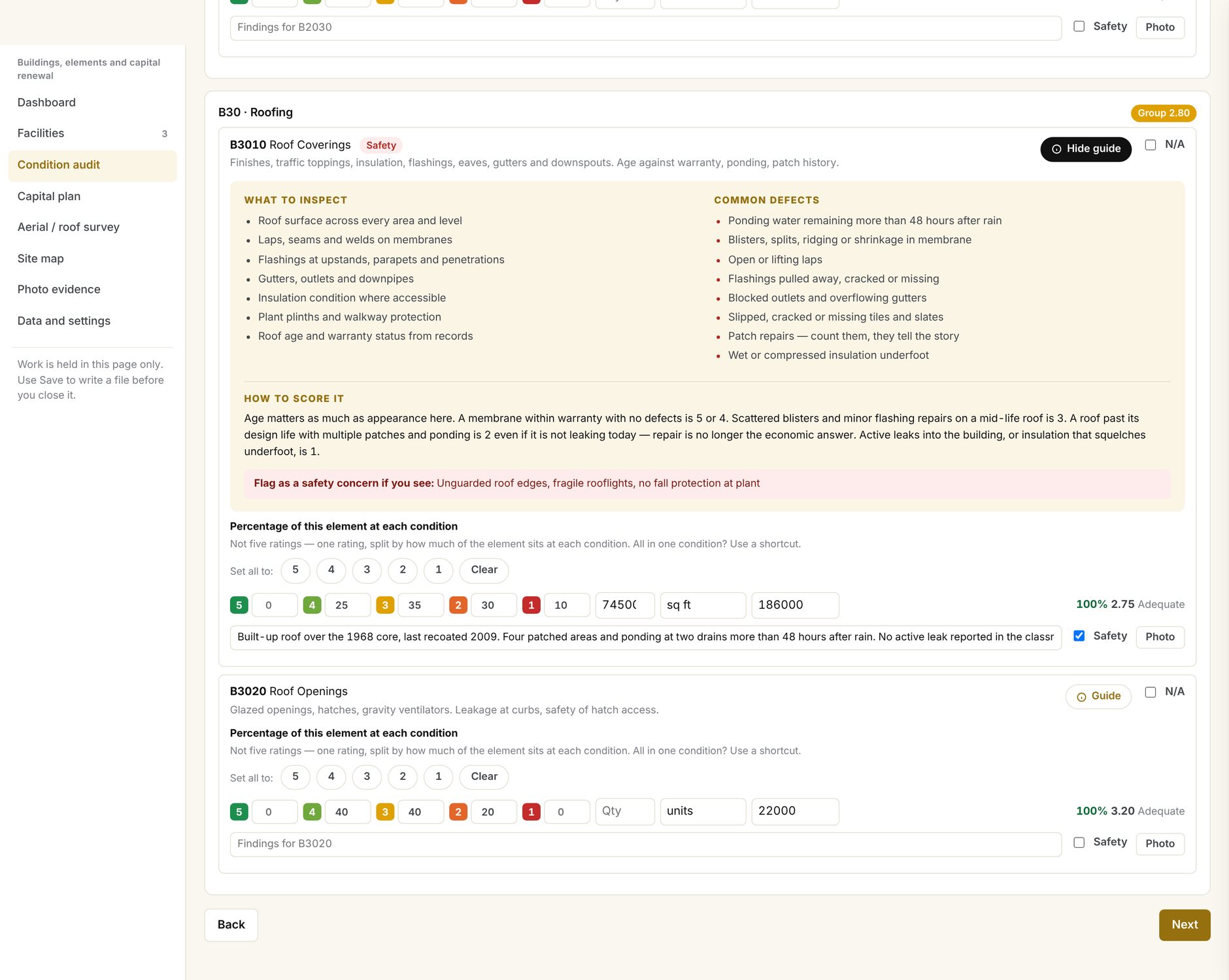
1–5Rated, not described Every element scored 5 Excellent to 1 Poor, by the percentage of its quantity in each state. Three or above is in good repair.

What comes out of it

Facility Condition IndexDeferred maintenance cost over current replacement value. The single number a board, a lender or a district office understands.
Deferred maintenance backlogWhat it would cost today to bring every element back to good repair, itemised by element.
Ten-year capital renewal planRenewal spend by year and by system, driven by remaining useful life rather than by whoever shouted loudest.
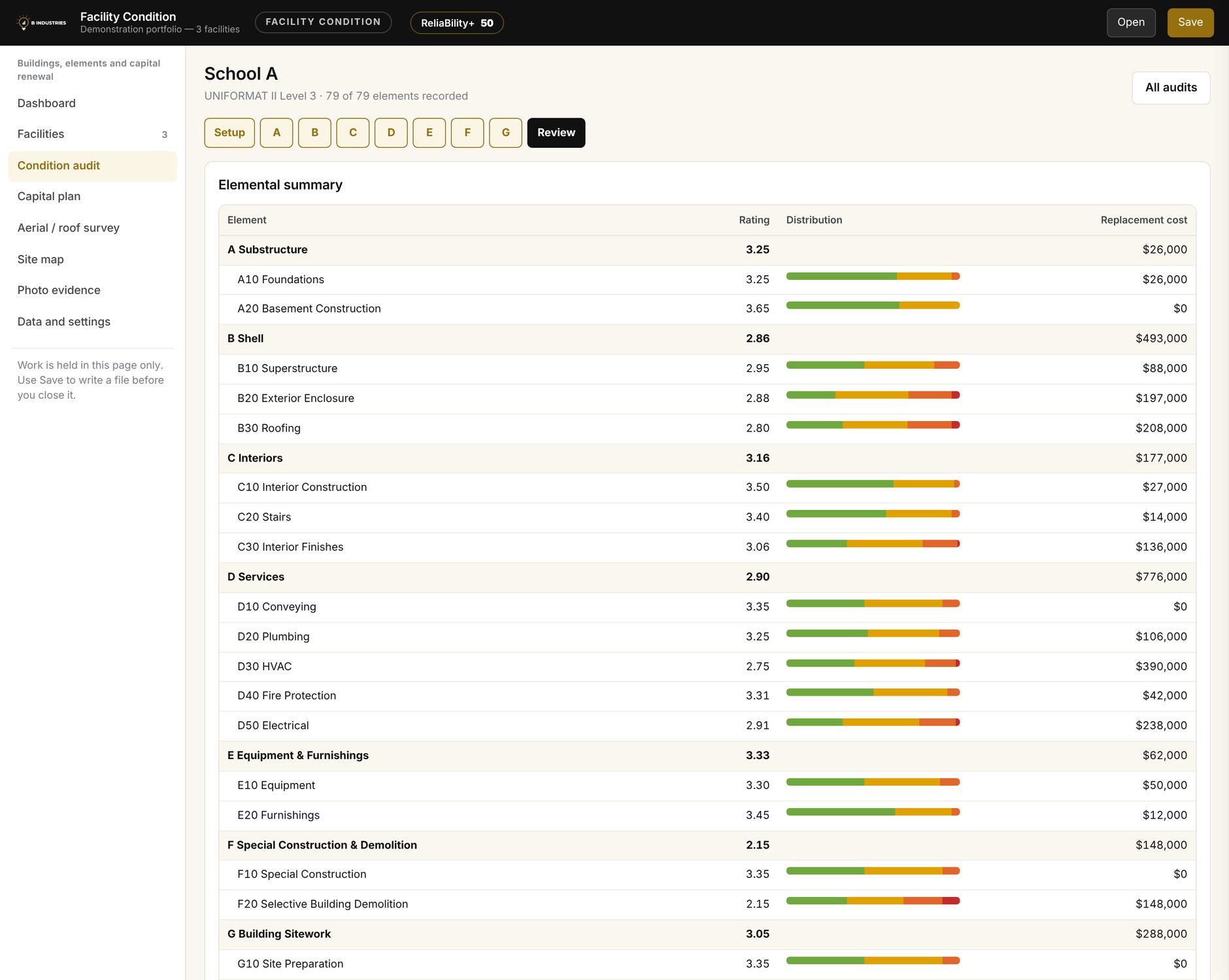
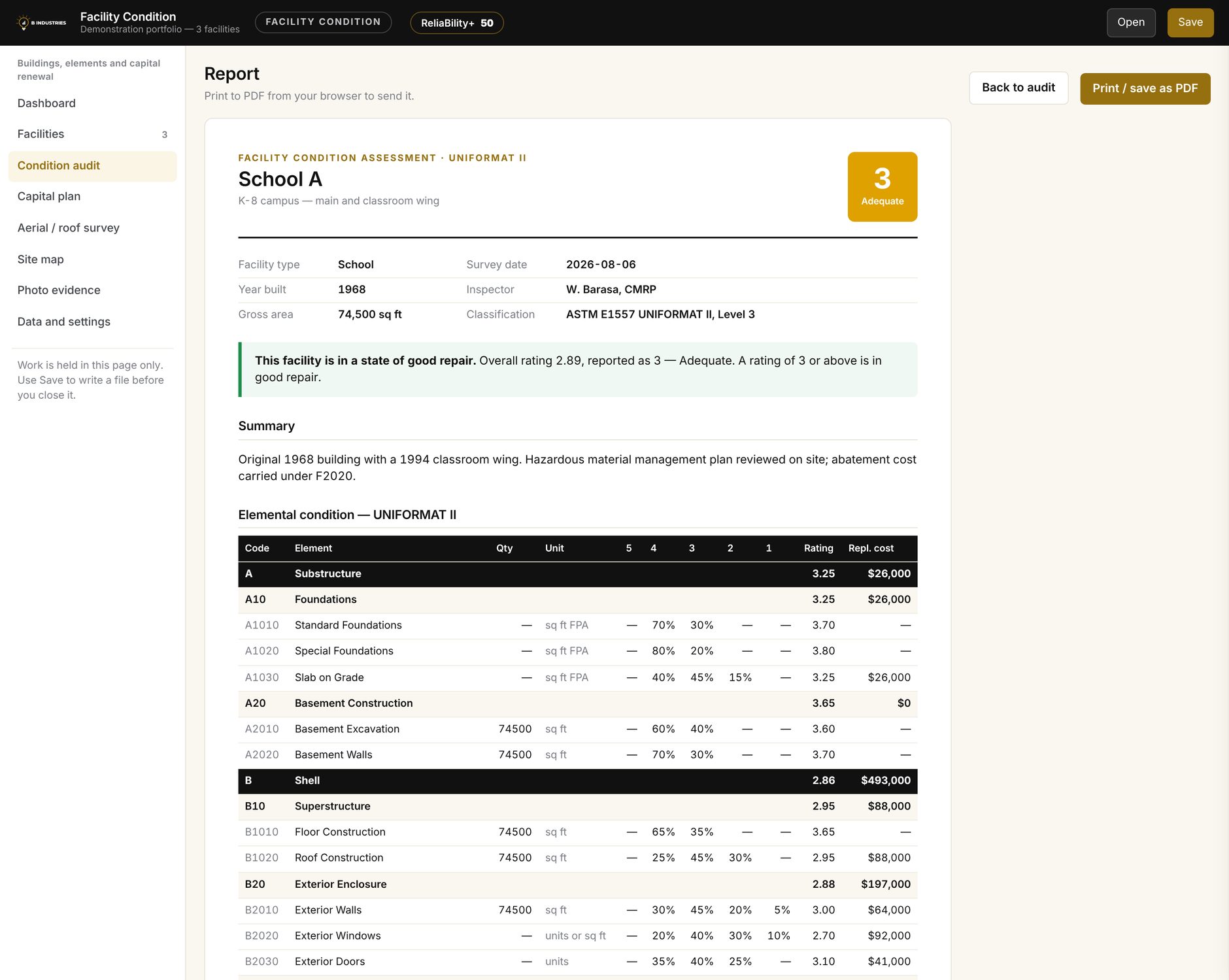
Elemental condition reportEvery element with its quantity, condition distribution, rating and replacement cost, rolled up through the hierarchy.
Priority and safety findingsWorst-first ranking, plus anything that needs a qualified review before a capital decision is made.
Photographic recordEvery finding evidenced. Drone survey of roofs, facades and thermal where access is the obstacle.

What makes a condition assessment defensible

Three things, and most assessments miss at least one. The classification has to be a recognised standard, so a second assessor reaches the same structure. The aggregation method has to be stated, because weighting by replacement cost and taking a median produce different answers from identical field data. And the field data has to record the distribution of condition across an element rather than one inspector's overall impression — a roof that is 70% failed and 30% sound is not a "fair" roof.

We do all three, every time, and the method section of the report states exactly which aggregation was used and what the assessment does not cover.

Reliability engineering

Maintenance programs
that survive a busy week.

A schedule built on assumption gets abandoned the first time production gets tight. A schedule built on criticality and failure modes gets defended. The difference is whether anyone did the analysis.

01

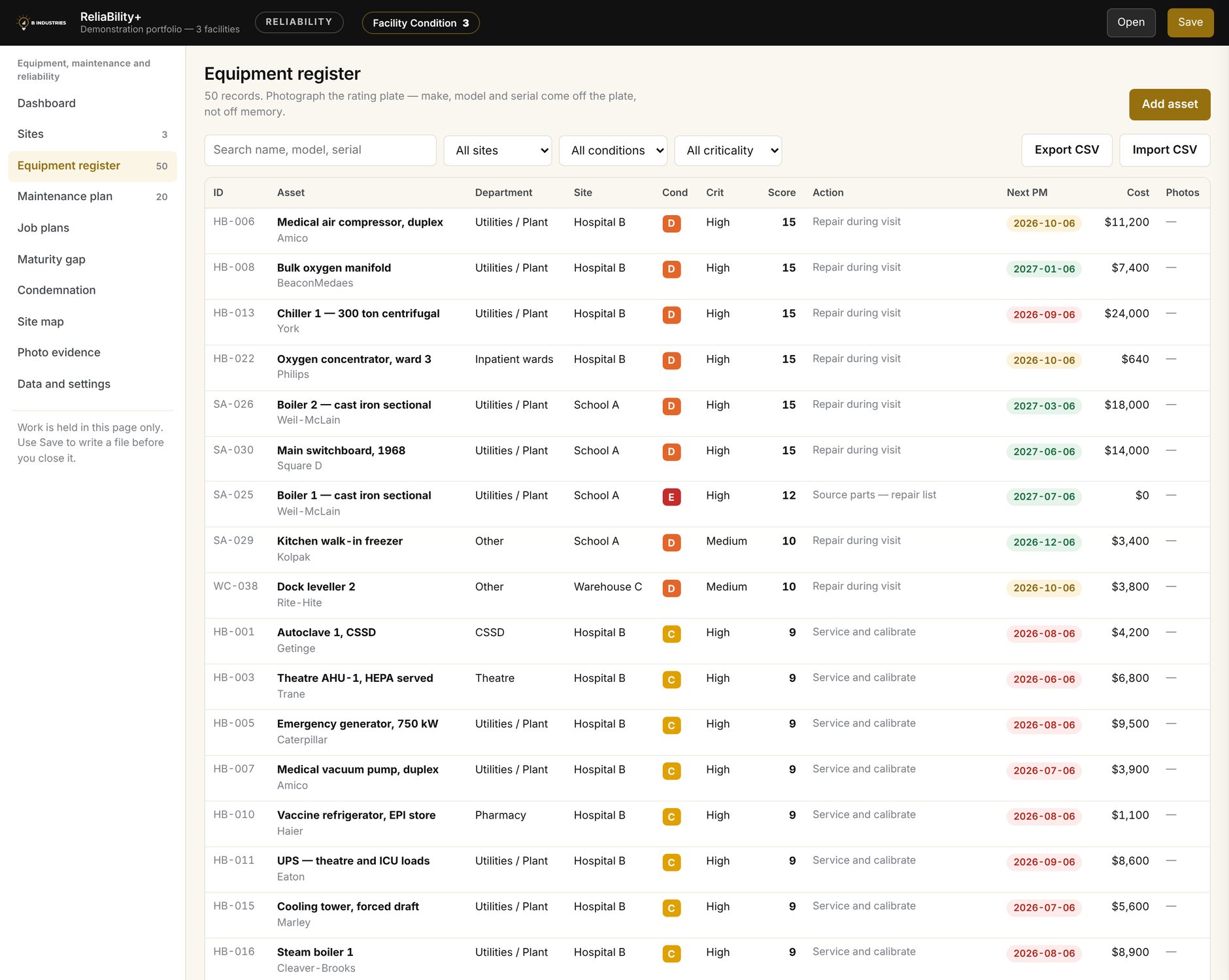
Equipment asset register

Walked and recorded, not estimated from a spreadsheet someone inherited.

  • Make, model, serial and location captured off the rating plate
  • Condition coded A to F, criticality ranked High, Medium or Low
  • Priority score of condition severity multiplied by criticality, so the broken thing in the production line outranks the broken thing in the storeroom
  • Photo evidence per asset, and a condemnation list for what should be written off
02

PM task plans matched to criticality

Tasks written failure-mode first: what you are looking for and why it fails, not "inspect the unit".

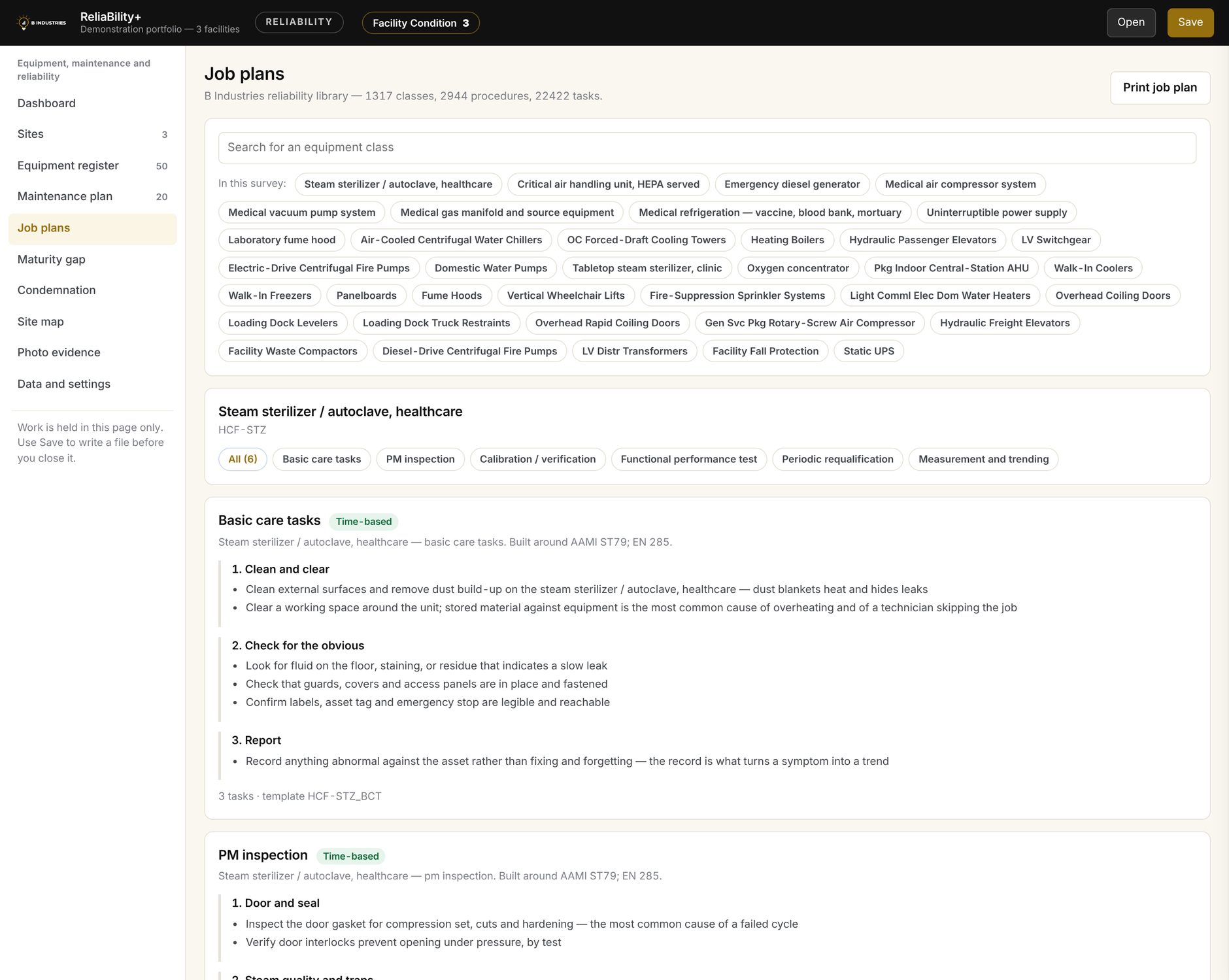
  • Job plans drawn from a library of over 1,300 equipment and instrument classes
  • Time-based PM, condition monitoring and calibration schedules, separated properly
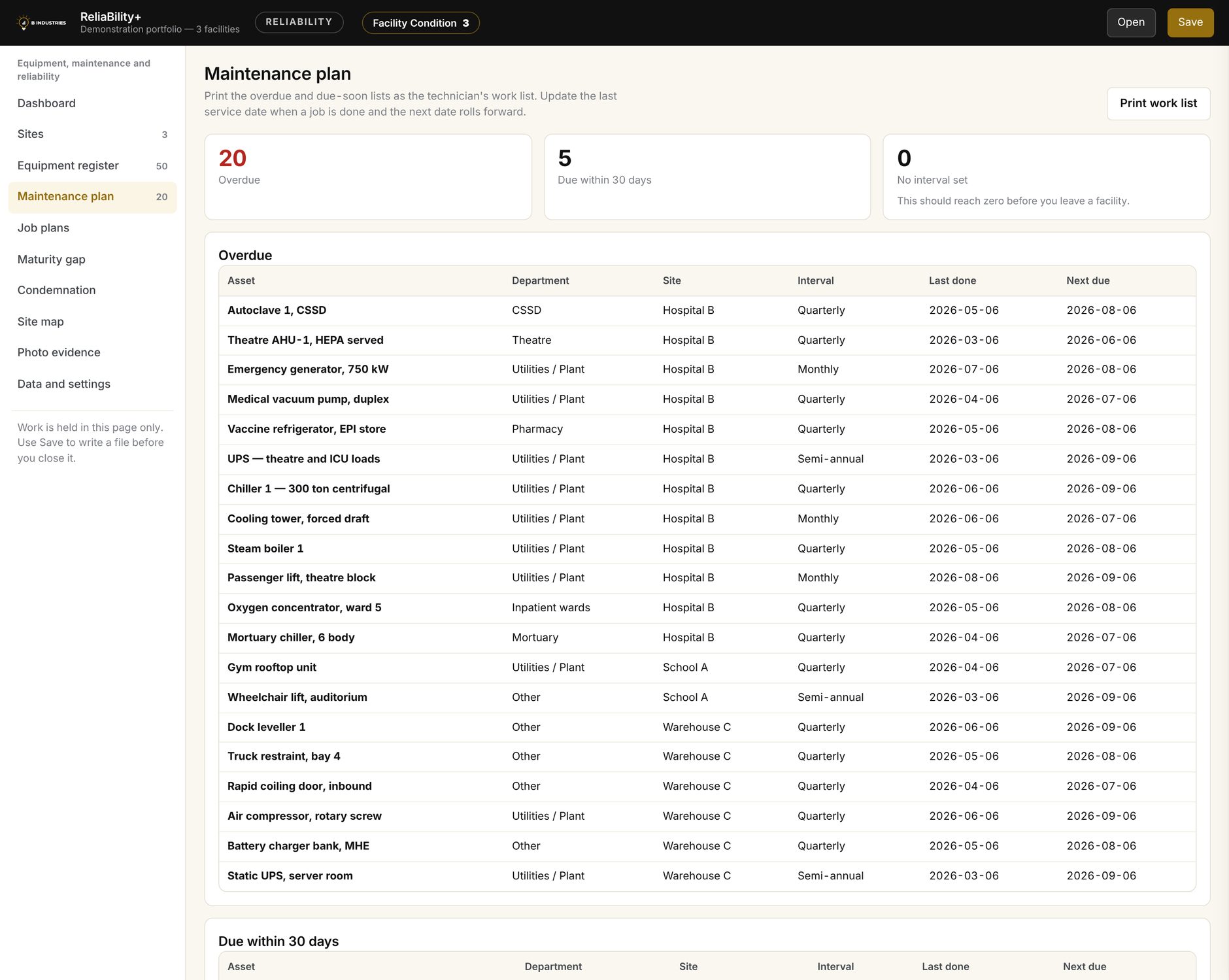
  • Frequencies weighted by criticality and tuned to your actual staffing — quarterly on critical assets that gets done beats monthly that does not
  • Printable technician work lists, and loading into your CMMS or one we set up with you
03

PM gap analysis, priced

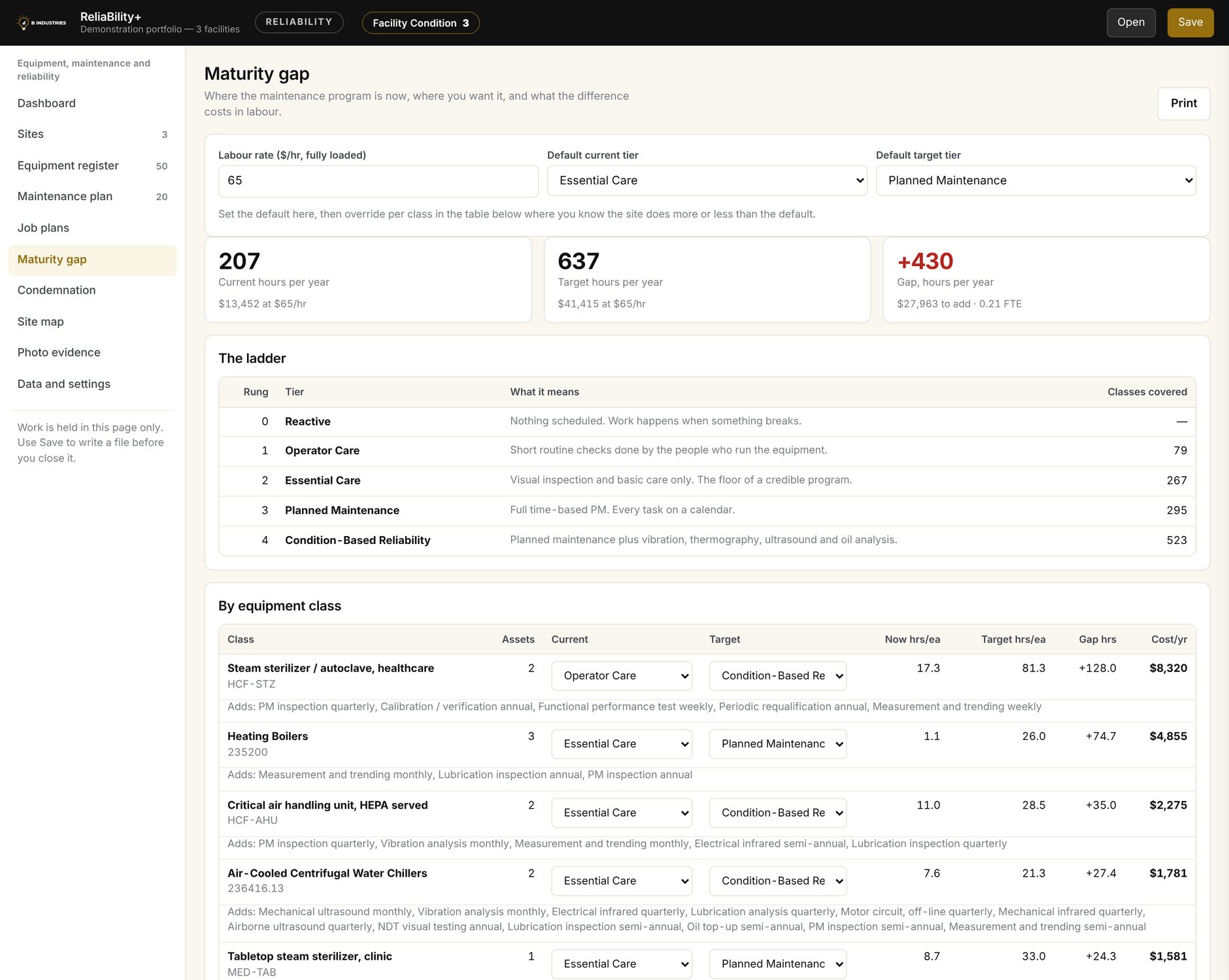
Where the program sits today, where it should be, and what the difference costs in labour.

  • Current state benchmarked against a defined maturity ladder, class by class
  • Gap expressed in hours per year, fully loaded dollars and full-time equivalents
  • Named tasks that get added — "adds mechanical ultrasound monthly, vibration analysis monthly, electrical infrared quarterly" — rather than an abstraction
  • A number a plant manager or a facilities director can take into a budget conversation
04

Capability building

If it only works while we are on site, it has not worked.

  • Coaching maintenance leads and operators, not just handing over procedures
  • Operator care routines that the people running the equipment can actually hold
  • Spare parts and criticality-driven stocking decisions
  • Handover of the register, the schedules and the job plans in a system your team can run

The maturity ladder

Every equipment class is placed on this ladder, current state against target. The gap between two rungs is a number, not an opinion.

RungTierWhat it means in practice
0ReactiveNothing scheduledWork happens when something breaks. Most small sites are here on most of their asset base, whatever the CMMS says.
1Operator CareRoutine checks by operatorsShort daily and weekly checks done by the people who run the equipment. Cheapest rung to add and the one that catches the most.
2Essential CareVisual inspection and basic careThe floor of a credible program. Enough to defend in an audit, not enough to prevent much.
3Planned MaintenanceFull time-based PMEvery task on a calendar, including calibration and functional testing. This is where most regulated sites need to be.
4Condition-BasedPM plus condition monitoringVibration, thermography, ultrasound, oil analysis and motor circuit testing on the assets that justify it. Not everything justifies it.

Not every asset should reach rung 4. Deciding which ones should is the actual work.

Who this is for

Organisations too small
for a national firm,
too big to guess.

If you own buildings and equipment but have no asset register, no condition baseline and no capital plan, you are the client. Here is what each sector usually finds.

Schools & districts

Small school districts and independent schools

Buildings acquired across decades, a capital request process driven by whichever roof failed last, and no defensible number to take to a board or a bond vote.

In any pre-1990 building, hazardous components abatement is frequently the largest single liability on the report — and the one nobody has priced. We assess it under F2020 and put a number on it.

Healthcare

Hospitals, clinics and county health facilities

Clinical equipment uptime measured in something other than dollars, plus building systems that carry life-safety obligations most facility teams are carrying alone.

UNIFORMAT has no dedicated medical gas element. We assess medical gas and vacuum under D2090, isolation and theatre air handling under D3090, nurse call under D5030, isolated power under D5090 — and say so in the report, so your estate team can find them.

Warehouse & distribution

Warehouses and distribution centres

Large envelope, thin building services, and a slab that is doing more work than anyone acknowledges until the racking starts moving.

Four elements carry most of the risk: slab on grade, roof coverings, sprinkler systems and yard pavement. We scope accordingly rather than charging you to survey offices you barely use.

Manufacturing

Small and mid-size manufacturers

Maintenance carried by two or three people who know everything and have written none of it down, and a capital plan that is really a wish list.

Process equipment that is not part of the building stays in the equipment register rather than being forced into the building classification. Both get assessed; they do not get mixed up.

Regulated manufacturing

Pharmaceutical, medical device and animal health

Calibration, requalification and environmental monitoring obligations sitting alongside ordinary maintenance, often in the same overloaded schedule.

Calibration, functional testing, electrical safety testing, environmental monitoring and periodic requalification are separate procedure types in our library — not notes appended to a PM.

Public & institutional

Municipal, transit and institutional estates

Reporting obligations that require a condition measure on a defined scale and a defined cycle, with no internal capacity to produce one.

We can report against either UNIFORMAT II or the FTA ten-component breakdown, on the five-point TERM scale, with the aggregation method stated.

Method

Measure, quantify,
sequence, embed.

Most programs fail at step one. An organisation cannot prioritise what it has never counted, and a plan built on assumption is abandoned the first busy week.

Step one

Count it

A complete register — building elements to UNIFORMAT II, equipment with make, model, serial, condition and criticality. Walked and recorded.

Step two

Price the gap

Deferred maintenance against replacement value for the buildings. Current maintenance effort against target for the equipment. Both in dollars.

Step three

Sequence the work

Condition severity weighted by criticality, and renewal driven by remaining useful life. The plan says what comes first and why.

Step four

Hand it over

Registers, schedules and job plans live with your team in a system they can run, with the people trained to run it.

Client tools

Survey Platform

The field tool behind every assessment. UNIFORMAT II condition audits, equipment registers, criticality scoring, maintenance planning, gap analysis and photo evidence — built to run on a tablet in a building with no signal.

Restricted access — clients and staff only
  • UNIFORMAT II audits to Level 3, with facility-type presets
  • Over 1,300 equipment and instrument classes
  • Printable job plans and technician work lists
  • Maturity gap and cost analysis
  • Drone and photo evidence per site
  • Works fully offline once installed
Contact

Tell me what's breaking.

wallacebarasa@gmail.com (269) 267-5870

Connect on LinkedIn

On site where it matters, remote where it doesn't.
Surveys and coaching happen in the building. Analysis, program design and reporting are done remotely.
First conversation is a call, not a proposal. If the fit isn't there, you'll get told that rather than sold something.
Typical first engagement: a two to four day assessment at a single site, producing a condition baseline or an equipment register, a quantified gap and a prioritised roadmap.